Dental Implants in Worthing
Considering dental implants in Worthing? An implant assessment can compare options for replacing one tooth, several teeth or most or all teeth in a jaw. We will assess your teeth, gums, bite, bone and medical history, then explain suitable options, reasonable alternatives, material risks and likely stages before you decide.
What dental implants can replace
Dental implants can support different types of replacement teeth. The appropriate restoration and the number and position of implants depend on what is being replaced and the findings from assessment.
One missing tooth
A single-tooth implant can support an individual crown without relying on the neighbouring teeth for support. Suitability depends on the space, gums, available bone, bite, adjacent teeth and medical history.
Several missing teeth
Implants may support a fixed bridge to replace several missing teeth. The number and position of implants depend on the length of the space, available bone, bite and restorative plan.
Implant-retained removable dentures
Implants can help retain a removable denture. The denture is removed by the patient for daily cleaning and differs from a fixed implant bridge. Read about implant-retained removable dentures.
Fixed full-arch bridges
A fixed full-arch implant bridge replaces most or all teeth in one jaw and is not removed by the patient for routine cleaning. Implant number and treatment stages depend on the individual plan.
If most or all teeth in one jaw are missing or failing, read about our All-on-4® treatment concept and fixed full-arch implant options.

Replacing one missing tooth with an implant
A single-tooth implant replaces a missing tooth without relying on the neighbouring teeth for support. The implant sits in the jawbone; an abutment connects it to a custom-made crown. The result is a fixed replacement, but the implant and crown still require daily cleaning and professional maintenance.
Assessment includes the space, gums, available bone, bite, adjacent teeth and medical history. X-rays are required. CBCT is used selectively when clinically indicated and may be taken at the Worthing practice or arranged externally. Gum disease and other oral problems need to be stabilised first. Some implant sites need bone grafting, while sinus augmentation may be considered for certain upper-jaw sites. These procedures are provided at the Worthing practice when clinically indicated, but they are not required or suitable in every case. An implant may not be suitable even after assessment.
Treatment usually involves planning, implant placement, a healing period, and fitting the abutment and crown. The sequence and timing vary.
Alternatives that may be discussed include leaving the space, a resin-bonded or conventional bridge, or a removable denture. Each has different implications for neighbouring teeth, cleaning, repair and treatment stages. We will explain reasonable alternatives before you decide.
Is implant treatment suitable for me?
Suitability can only be decided after assessment, and implants are not appropriate for everyone. Relevant factors include gum health, oral hygiene, available bone, the bite, remaining teeth, medical history, medicines, smoking or vaping, and the ability to clean and attend maintenance appointments. Other dental or gum treatment may be discussed first, but an implant may still not be suitable.
Your implant assessment and treatment plan
Your assessment includes your concerns, medical and dental history, the condition of your teeth and gums, your bite and the available bone. Appropriate X-rays are required. CBCT is used selectively when clinically indicated and may be taken at the Worthing practice or arranged externally.
Planning considers the available bone, gums, bite, medical history and long-term maintenance needs. We will explain the proposed implant and restoration, reasonable alternatives, material risks, likely stages and maintenance requirements.
Dr Amir Mostofi principally carries out the surgical and restorative stages of implant treatment, with other team members involved where appropriate. The practice also accepts implant referrals from other dentists.
Treatment stages and temporary teeth
Treatment stages vary with the site and the planned restoration. They commonly include assessment and planning, implant placement, a healing period, restorative scans or impressions, and fitting the crown, bridge or denture. Extractions, bone grafting, sinus augmentation or other dental treatment may alter the sequence.
Healing normally takes several months and varies according to the jaw, the procedure and individual healing. The restoration is fitted according to the clinical and restorative plan rather than a fixed universal timetable.
A temporary tooth may sometimes be provided where clinically suitable. Its type, timing and whether it is fixed or removable depend on the individual treatment plan. Immediate placement or loading is not guaranteed.
Discomfort, risks and aftercare
Local anaesthetic is used to numb the area. You may feel pressure or movement; discomfort afterwards varies. Swelling or bruising may occur, and you should follow the individual instructions provided after treatment.
If you are anxious about treatment, ask whether clinic-based sedation may be suitable. Availability and suitability are confirmed after assessment.
Not every implant integrates with the bone. If this occurs, it may need to be removed and the next options discussed. Other possible problems include infection, delayed healing, gum or bone changes, damage to surrounding structures and technical complications affecting an implant, abutment, crown or bridge. Risks vary by site and medical history and will be discussed before treatment.
Cleaning and long-term maintenance
Implants and implant-supported restorations require daily cleaning and professional maintenance. Cleaning methods depend on whether you have a crown, bridge or removable denture, and the dental team will show you how to clean around the implant and restoration.
Review appointments assess the gums, cleaning, bite, implant and restoration. Maintenance frequency is based on oral hygiene, clinical risk and findings. Restorations and components can wear, loosen or break and may need maintenance, repair or replacement.
Implant problems and urgent assessment
If an implant or implant-supported restoration becomes loose, painful, swollen or damaged, contact the practice for advice. See our information about urgent implant problems.
Arrange an implant assessment in Worthing
The practice provides implant assessments for patients in Worthing and surrounding areas of West Sussex.
After assessment, we will provide a written estimate for the proposed treatment.
Call 01903 821822 to arrange an implant assessment.
Book an implant assessment online.
Nobel Biocare and All-on-4 are trademarks of the Nobel Biocare group.
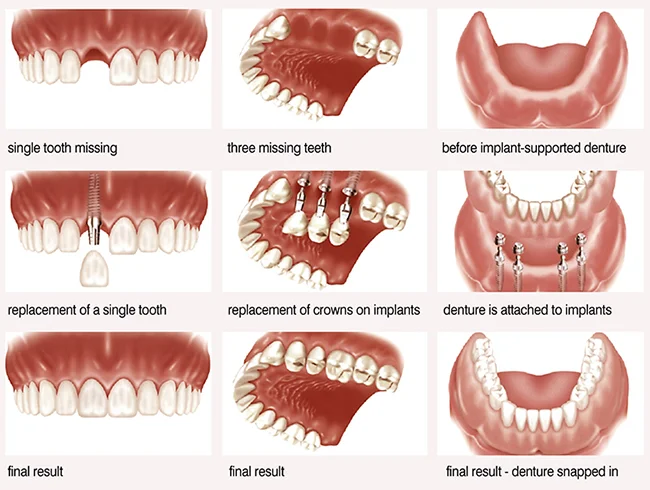
Tooth implant, Bridge over implants and overdenture at Worthing dentist clinic.